Teenage Marley: A Tropical Display Font for Handmade Brands
If you’ve ever held a hand-poured candle with a tiki-inspired label, opened a birthday invite that made you smile before reading a word, or paused at a boutique tag that whispered “vacation vibes”—chances are, you felt the quiet magic of intentional typography. That’s exactly where Teenage Marley lives: not just as a display font, but as a tactile, sun-warmed design asset built for makers who sell *feeling*, not just products.
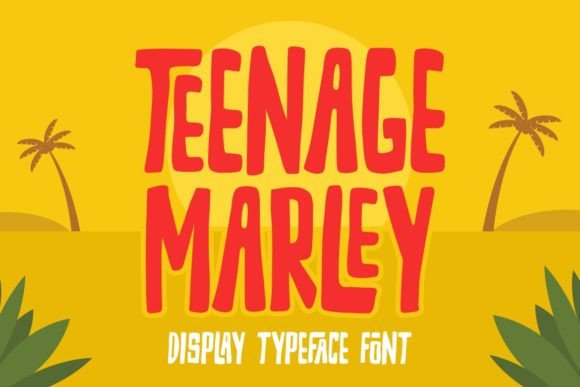
Teenage Marley is a bold, friendly display typeface with rounded terminals, relaxed curves, and a subtle island rhythm in its letterforms. It doesn’t shout—it leans in, grins, and invites your customer to linger. Think bamboo signage at a coastal café, vintage tiki bar menus reimagined for modern weddings, or sticker sheets for tropical-themed planners. Its personality is warm, approachable, and unmistakably handmade—no sterile vector perfection here, just cheerful, human-scaled charm.
What makes Teenage Marley especially practical for crafters? First, its extensive ligature set. Words like “island,” “aloha,” “tropical,” and “beach” flow together seamlessly—not as gimmicks, but as natural, readable connections. That means cleaner cuts on Cricut and Silhouette machines, fewer overlapping layers in SVG files, and smoother printed results on small product tags or 2-inch stickers. No more manually adjusting kerning on “ff” or “fi” combos—Teenage Marley handles it gracefully, so your time stays focused on creating, not correcting.
I use Teenage Marley most often for short, high-impact applications: candle jar labels (especially coconut or pineapple scents), boutique gift tags, wedding welcome signs, printable wall art for nurseries and sunrooms, and digital planner covers aimed at wellness and travel creatives. It shines on physical goods where legibility meets mood—like a linen tote bag with “Good Vibes Only” in Teenage Marley, or a kraft paper sticker reading “Handcrafted in Hawaii” beside a small-batch hot sauce bottle. Because it’s a display font—not meant for body text—it performs best at sizes 24pt and up, and truly sings at 48pt+ on signs, posters, and social media graphics.
Readability matters deeply when your font ends up laser-cut, foil-stamped, or screen-printed. Teenage Marley’s generous x-height and open counters mean it holds up beautifully even at 16pt on a 1.5-inch product tag. I’ve tested it on matte vinyl stickers applied to curved mason jars—no letter collapse, no awkward spacing. On printed greeting cards, it scans cleanly without ink bleed, and its consistent stroke weight ensures crisp edges whether you’re printing at home or sending to a local print shop.
Pairing Teenage Marley thoughtfully elevates your whole brand system. For contrast and clarity, I often combine it with a clean sans serif like Montserrat or Poppins for supporting text—think “Teenage Marley” for the headline “Island Sunset Candle,” then Montserrat Light for the scent description underneath. If you’re designing wedding stationery, try layering it with a delicate script font (like Pacifico or Allura) for names, letting Teenage Marley anchor titles and headings. It also works surprisingly well beside a gentle serif—say, Lora or Playfair Display—for vintage-inspired apothecary labels or boutique packaging where warmth meets refinement.
Before downloading, check what’s included: Teenage Marley typically ships with OTF and TTF files, basic and discretionary ligatures, stylistic alternates (like a swash “y” or alternate “a”), and support for Latin-based languages—enough to cover English, Spanish, French, and Portuguese projects without hitch. No extended multilingual glyphs, but more than enough for Etsy shops, farmers’ market vendors, and indie stationery brands serving North America and Western Europe.
Here’s where real-world practice meets licensing: Teenage Marley is a commercial font, meaning you *can* use it to design and sell physical products—candles, shirts, mugs, stickers—as long as you’re not reselling the font file itself. You may also use it in digital downloads (planner pages, Canva templates, SVG cut files) and client work (like custom invitation suites for a beach wedding). Just avoid embedding it in apps or web fonts unless your license explicitly allows it. Always double-check the vendor’s terms—but most reputable sellers include full commercial use, which is essential when your livelihood depends on reliable, legally sound design assets.
Seasonally, Teenage Marley is my go-to for summer launches, tropical baby showers, luau parties, and even unexpected moments—like a citrus-scented soap line marketed as “Sunshine Therapy.” It softens holiday packaging too: imagine “Merry & Bright” on a kraft box tied with raffia, or “Joyful Tidings” stamped on handmade ornaments. Its versatility isn’t about being everywhere—it’s about being *right* where it lands.
One thing I love about using Teenage Marley across multiple product lines is how quickly customers begin recognizing it—not as a font, but as *my* visual shorthand for carefree quality. When someone sees it on a sticker, then again on a wedding sign, then on a printable planner page, there’s an unspoken thread of consistency. That builds trust. That turns one-time buyers into repeat fans. And that’s the quiet power of choosing a display font that’s as functional as it is joyful.
So if your next batch of handmade goods needs a little sunshine in its typography—if your digital downloads deserve a voice that’s both playful and polished—give Teenage Marley space to breathe on your mockups, your cutting mats, and your customer’s shelf. It won’t fix a weak product, but it *will* make your best work feel even more inviting, intentional, and unmistakably yours.